
Floating on Parched Air
Field Notes Alongside a Thirsty River + Book News

The 2026 atmosphere is heavy. To stay afloat, I make time, be it moments or a few days, to focus on what is in front of me.1
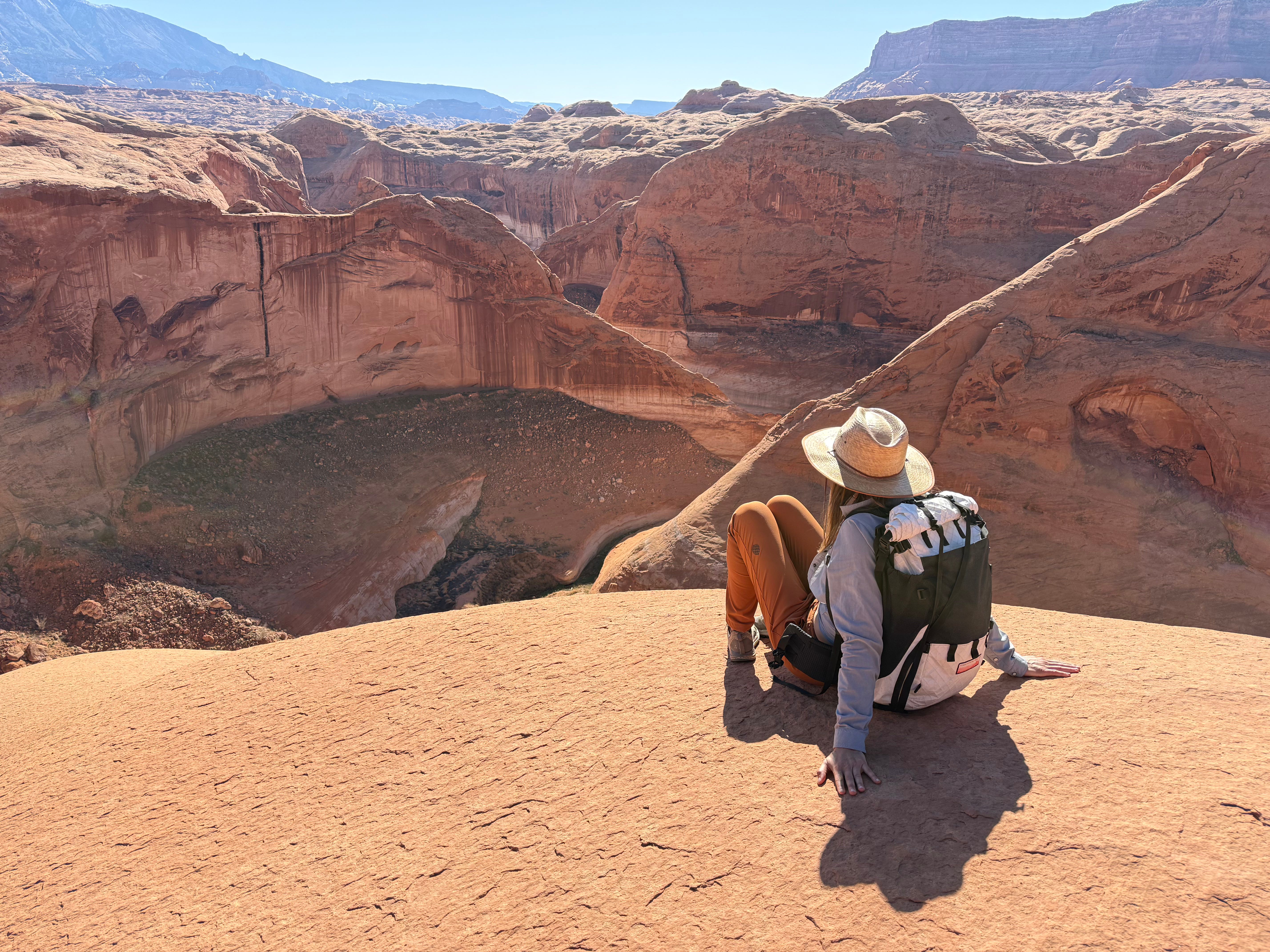
Let me begin again. The 2026 atmosphere is heavy, and in the Southwest, it is achingly dry. Despite racing thoughts from multitudinous directions that keep me up at night, it is my parched throat that first alerts me to wake. I thank the overlords of aridification, both in sky and skyscraper, for helping redirect my priorities. Without water, little do other problems matter.2


From the Navajo Sandstone rim, one hundred feet or more above a Glen Canyon tributary, running water broke the mid-winter silence. Peering over the precipice rock mound, we watched the perennial stream trickle through bedrock, now long-scoured of reservoir sediments. Between our vantage and the water, the white bathtub ring, stained with iron-rich streaks of red, appears faded.
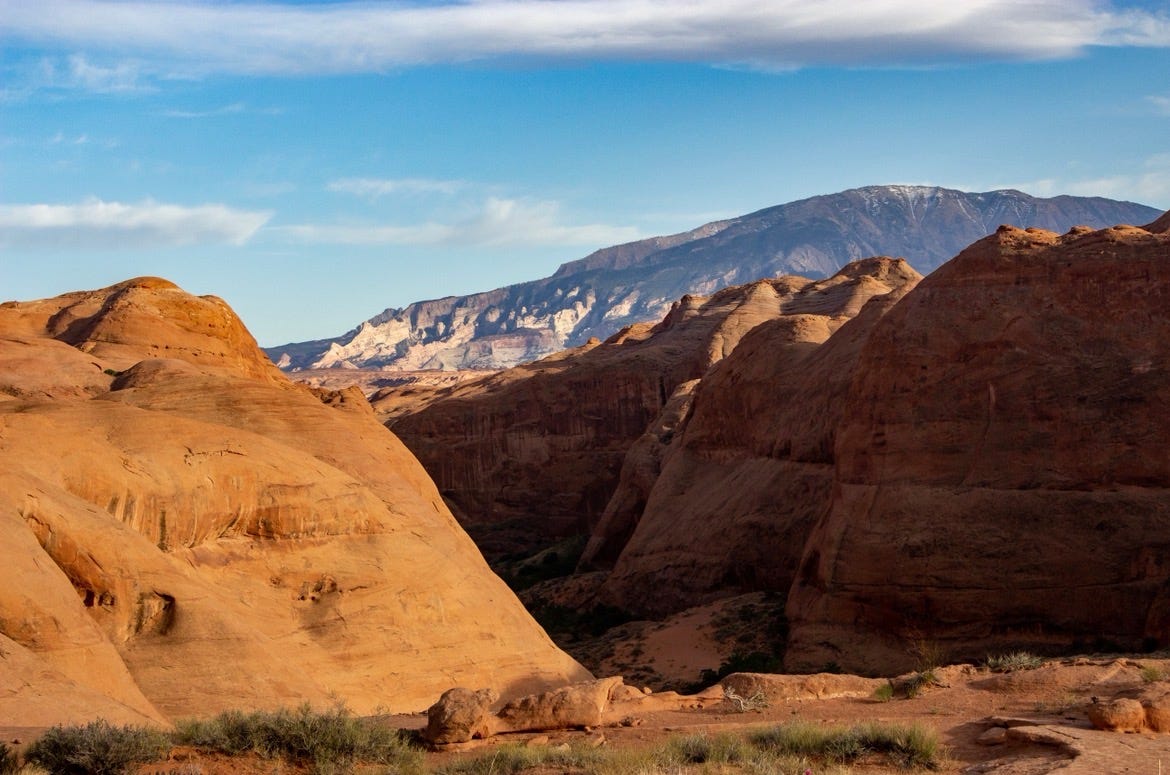
This downward trend is likely to continue, as this winter is shaping up to be the worst in 40 years, as reported by Jonathan P. Thompson (The Land Desk). While late fall and early winter rains, coupled with warm temperatures, induced a winter super bloom in parts of the Mojave, Sonoran Desert, and even swaths of the Colorado Plateau, these are precisely the conditions creating a snow drought. As this NASA report explains:
“Precipitation falling as rain tends to run off before it can recharge reservoirs and groundwater. On the other hand, winter snowpack that melts in the spring can produce a more metered, sustained water supply. The health of the mountain snowpack has implications for ecosystems, wildfire dynamics, and water availability for agriculture and other uses during drier times of the year.”
No, the water year is not over, but even the miracle winters like 2019 and 2023 do not keep us out of trouble. 3 Nor have past efforts from Governor Cox urging us to pray for rain in Utah. He has added fasting to the request this year.
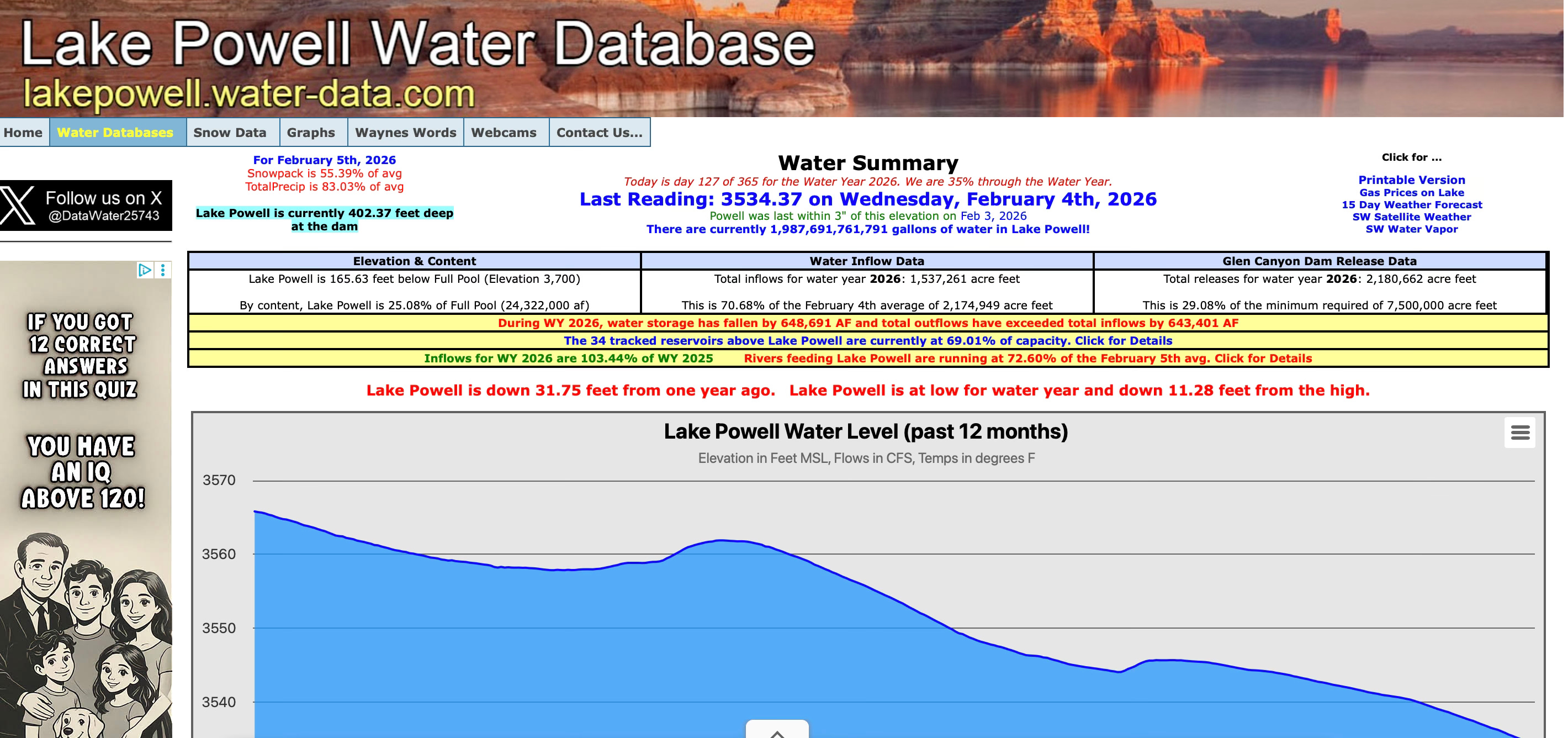
Last month, the Bureau of Reclamation (BOR) released its Draft Environmental Impact Statements for Post-2026 operations of Powell and Mead Reservoirs. While the management is being renegotiated to prevent a system crash, all models show dangerously low water levels in the two major reservoirs as likely between this water year and next. To this, Glen Canyon responds to the reality that we do not need words like climate change to see.4
Unlike typical NEPA processes, the BOR has not highlighted a preferred plan. Perhaps no plan is actually preferable for an unpredictable future? The proposed plans were drafted under a “Decision Making under Deep Uncertainty (DMDU) approach, drawn from a well-established branch of decision science, that is designed to account for uncertainty in future Basin conditions.”
Last week, I sat through the BOR public meeting in which they read through the document aloud. Though these public meetings are fundamentally important to democracy, I found the format more insufferable and less enlightening than reading the document, which I am still very slowly working through. I travel into the backcountry with documents like this loaded on my Kindle––long nights in a tent with nothing else to do are the only way I can convince myself to do this.
Since 2017, I have ranged widely, spending months of my life in the backcountry for glimpses of Glen Canyon’s return. Human-induced climate change, coupled with the negligence of the realities of life in the desert, is orchestrating quite a show. It is not that I celebrate doom, it’s that I relish witnessing beauty and rebirth amid wanton environmental abuse. For years, this gave me hope adjacent to the liminal space my life was centered upon.
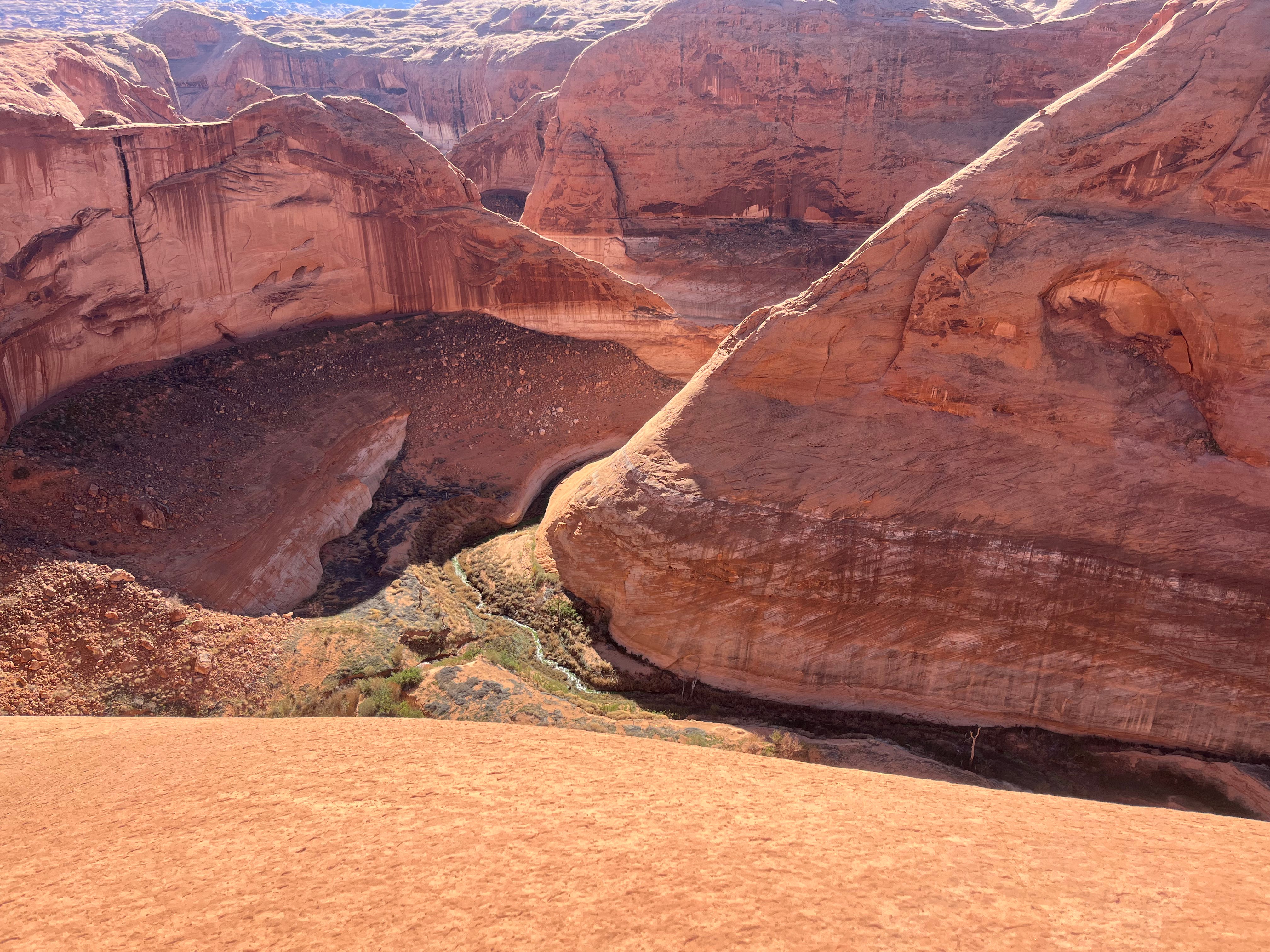
My love for this landscape and belief in restoration remains steadfast, but I am no longer so singularly focused. The returning Colorado River, and the life she nurtures in Glen Canyon, has taught me to watch the steps in front of me, but to also navigate a longer view. Landscape miracles such as this continue throughout the Colorado River watershed. Water supporting life in such arid lands is in itself a miracle. And that water, despite its present mutant barriers and diversions, connects me (and you) with more life than any algorithm can attempt to divide us from.
One thing is very clear about the proposed Post-2026 plans: the brunt of water-use reductions will be placed on the lower Colorado River Basin. The upper basin is not subject to mandatory cuts in periods of drought. While a February 14 deadline has been set for states to create their own plan, still not submitted among the others in this proposal, another alternative looms: litigation. The Arizona House Committee just passed a bill to set aside $1 million for Colorado River legal fees. The bill moves to the AZ Senate next.
Debates on upper versus lower basin water use, often framed as “water wars,” are as old and tired as the 1922 Colorado River Compact. Picking sides will not result in a winner––not if we consider that the Colorado River must survive this madness if we are to survive as well.
My low-tide fantasies of Glen Canyon emerging victorious from the chaos run deep. But they are shifting. The returning landscape is only a fragment of the Colorado River that was. To choose one area to “save” or “preserve” at the expense of another would ultimately kill the river.


There are more questions than answers. And I have more still. And they won’t be found in a thousand-plus-page government document. The truck is packed with backpacks, drybags, binoculars, field notebooks, maps, and historic expedition books. The lower basin beckons. My heart flutters in anticipation of a reunion with vivacious southern wildlife habitats. These landscapes, too, are embedded in my inner geography. Together, all watered by the same river. 🌀
What now?
I am pleased to share that I am writing a book about the Colorado River Watershed for Torrey House Press.
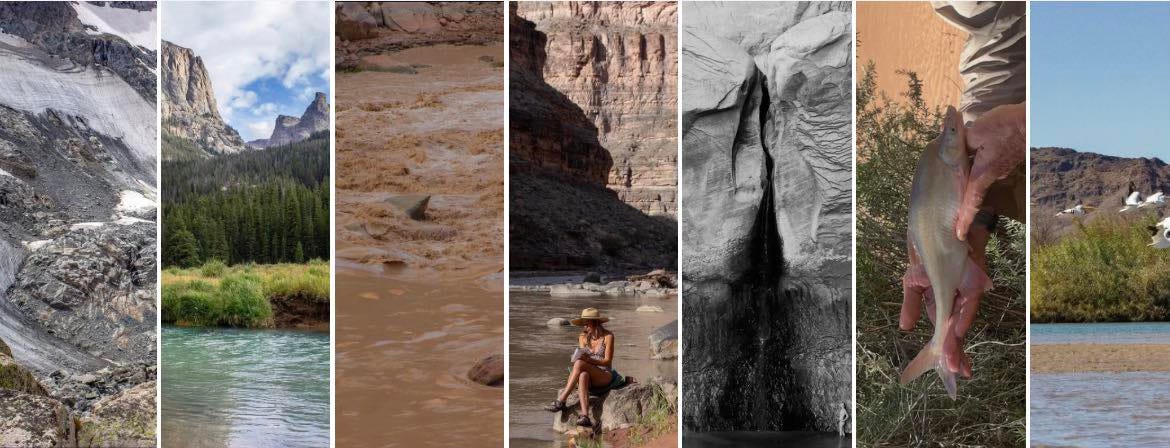
Details to follow in time. While it may be preferable for some authors to keep their projects hush until a pre-order link is available, that is too much of a secret to keep from the readers who have helped make this possible.
A publishing contract with an indie press is not a life-changing sum of money; it is belief and a green light to go forth with one’s obsession. In my case, it supports the watershed explorations flowing as the undercurrent of my life for almost a decade. This support also includes everyone who subscribes to Wild Words. Paid subscriptions have functioned as a pre-book advance to work on an early manuscript draft and proposal over the past 2+ years.
It has taken me some time to assess how Substack serves both my writing and a community of readers. While I admire the hearty journalists who have taken up reporting beats on their own platforms (and please subscribe to those I recommend), I have not and likely will never be a newsroom reporter with the tenacity to break news daily or even weekly. I am also not a writer who functions well without an editor. (Is anyone?) But, as someone editing my work yesterday pointed out, at least my prolific typos show that I am a human writer, not AI.
I trend toward the long-view, both in writing and my penchant for human-powered-endurance-travel. Though holding a physical book one has written is a tremendous privilege, navigating the challenging terrain of the writing and research process is what I relish. And because writing is such a solitary pursuit, it is invigorating and joyful to share moments and photos of this journey with you.
I hesitate to ever try to make Wild Words more than it is––an outlet for the untamed confluence of observations, research, and reporting rattling around in my head as I walk, float, run, and dream through the many still wild places in the West. Often, we only need to walk a few steps off the highway to observe the raucous life the biotic community is living in plain sight!
Wild Words are my field notes and postcards to each of you. They also remain love letters to the river threading the land that holds me through the darkest nights…and decades. Thank you for being here.
This is my disclaimer that I care deeply about so much happening in this country and the world, but as a writer, I cannot and should not try to tackle it all. That is, in a sense, letting the bastards win by fraying ourselves in too many directions and diluting the unique capabilities we have to offer the world. Writing, much like social media, is not in itself an action. Though it fulfills a critical space of communication, shared introspection, and hopeful inspiration, it is up to each of us (including the author themselves) to take up real, meaningful action once our eyes leave the page or screen.
Both The Land Desk by Jonathan P. Thompson and Hidden Waters by Daniel Rothberg offer excellent breakdowns of snowpack and drought conditions.
Although that word, like most words, is critically important. And not just for the environment, but as a marker of our First Amendment Rights. Climate Change is notably absent from the post-2026 DEIS, yet the charts and graphs clearly illustrate the changes we are all experiencing.
FUN!
On March 5, I will join author and water woman Becca Lawton in conversation. I fell in love with Becca’s gorgeous book The Oasis This Time long before we connected here. This is a pinch me beacon on my calendar. 🤎 🌀 Paid subscribers to her substack “Reading Water” can send her questions for me before the noon March 5 event.
Congrats on your book deal! And I love the phrase "a green light to go forth with one’s obsession."
Looking forward to this book!